Understanding your hair means understanding how it speaks with water. This is exactly where hydration is played out. And this is, too, where many mistakes in care take root.
Much is said about "hair type" — 2A, 3B, 4C — but these categories, although useful, describe only the shape of the curl. Two people with the same type can have hair that behaves in radically different ways. The most determining variable, the one that conditions how your hair retains hydration and absorbs treatments, has a name: porosity.
What is porosity?
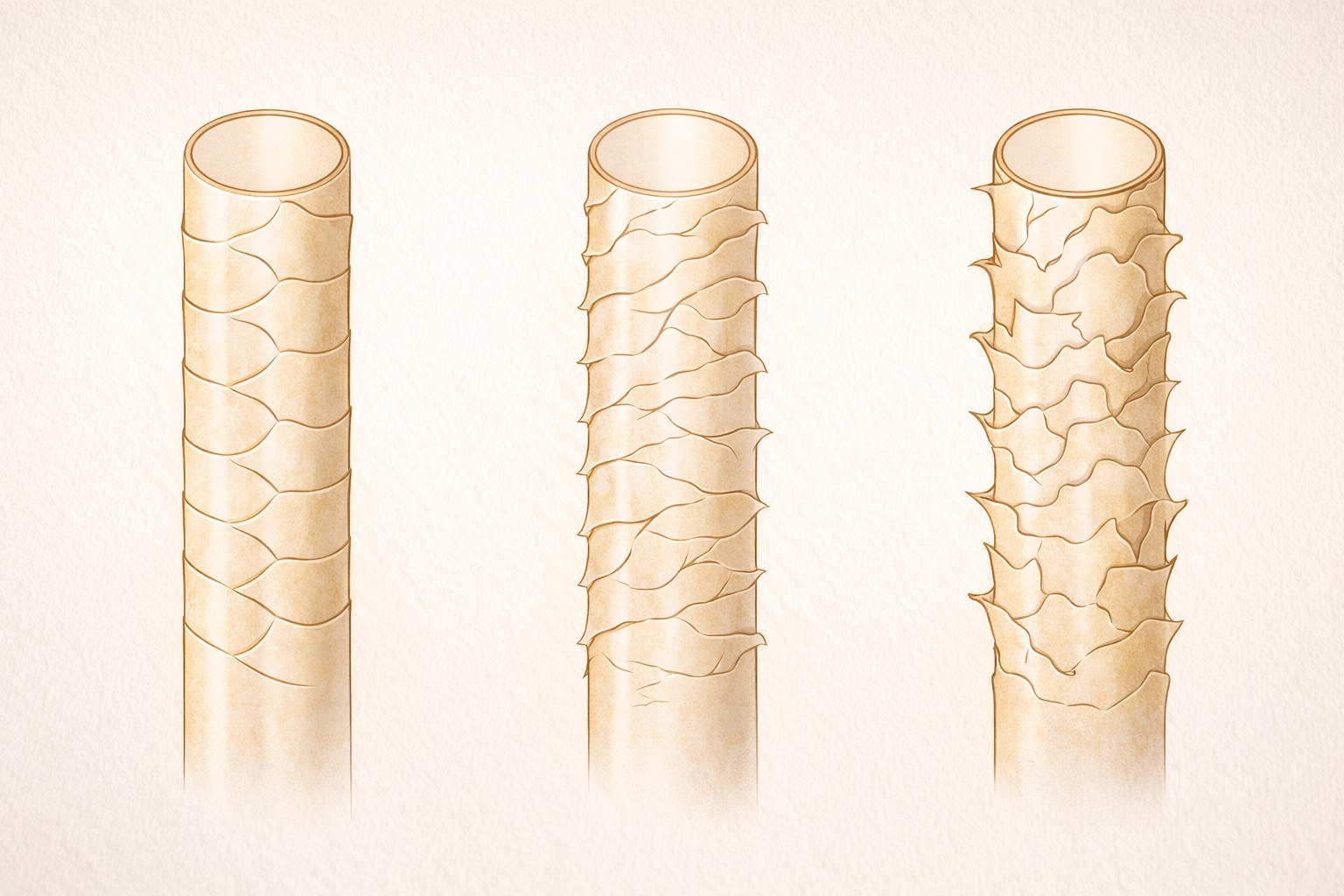
The hair shaft is composed of three layers. In the center, the medulla. Around it, the cortex — which gives hair its strength, color and suppleness. On the outside, the cuticle: a protective layer made of microscopic scales, arranged like the tiles of a roof.
When the cuticle is closed and well-aligned, water enters slowly into the hair and remains there for a long time. When it is raised, open, irregular, water enters easily but leaves quickly. This variation is called porosity.
Three main porosities are distinguished: low, medium, and high. Each calls for a different care logic.
The test — five minutes to know
To know your dominant porosity, a simple test is enough. It does not replace a professional diagnosis, but it gives an excellent indication.
- Take one or two clean, dry hairs — naturally fallen, for example from your comb.
- Fill a glass with room-temperature water.
- Gently place the hair on the surface, without submerging it.
- Wait two to four minutes without moving the glass.
- The hair stays on the surface → low porosity.
- The hair slowly descends to the middle → medium porosity.
- The hair quickly sinks to the bottom → high porosity.
Heterogeneous hair can behave differently depending on the zone sampled — roots, mid-lengths, ends. It is quite normal to have several porosities on the same head of hair, especially when the lengths are old, colored or often styled.
Low porosity
Hair that "resists" water
The cuticles are perfectly closed, the scales well flattened. Water struggles to enter — this is noticeable during shampooing: the hair takes time to become saturated, and treatments seem to sit on the surface without penetrating.
This is often the case with very healthy hair that has never been colored or heat-styled, or with young heads of hair. Paradoxically, this hair may appear "dry" when it is simply under-hydrated — water has never been able to enter.
What works
- Work with lukewarm water, even warm, to help lift the cuticle during treatment.
- Prefer light and fluid textures — dense creams slide away without penetrating.
- Apply masks with a heat source (warm towel, cap) to open the cuticle.
- Avoid oils that are too heavy, which saturate the surface without contributing anything inside.
Medium porosity
The sought-after balance
This is the most comfortable profile: the cuticle opens enough to let treatments in, and closes enough to retain them. The hair dries at a normal rate, absorbs products without difficulty, and holds its hydration for several days.
This hair does not demand specific care — it demands regular care. The standard ritual works perfectly, and this is where the most beautiful long-term results are observed.
What works
- A simple ritual, three products, sustained over time.
- A weekly mask is enough to maintain fiber quality.
- Vary water temperatures with the seasons: warmer in winter, cooler in summer.
High porosity
Hair that "drinks" everything
The cuticle is raised, sometimes damaged. Water enters quickly and leaves quickly. This hair is often described as "thirsty": it drinks in treatments in seconds and seems ready to absorb more. It also dries very quickly — which, contrary to intuition, is not a good sign.
This is frequently the case with colored, bleached, heat-styled hair, or simply hair heavily challenged by climate, hard water or time. Its mechanical fragility is increased: it breaks more easily, frizzes at the slightest humidity, loses its definition hours after styling.
What works
- Rich, nourishing textures, capable of filling the breaches in the cuticle.
- A regular supply of heavy oils — Baobab, Castor, Avocado — that seal hydration once deposited.
- A mask twice a week, or even more during periods of great cold or hair stress.
- A final rinse with cool water: it helps to close the cuticle and trap the actives.
The ETHNEIA ritual and porosity
The collection has been designed to work on all three porosities — this is precisely the object of its construction in three acts. Hydra Curl cleanses gently without degrading the cuticle. Condi Curl deposits its sheath according to the fiber's needs — light on low porosities, more adherent on high porosities. Nutri Curl provides the density necessary for fragilized hair, while remaining sufficiently penetrating for less receptive fibers.
When porosity changes
Porosity is not fixed. It evolves with the life of the hair: coloring, heat, pollution, climate, age. A single person can move from medium to high porosity within a few years, without noticing.
This is why it is useful to redo the test from time to time — once or twice a year — and to adjust the ritual accordingly. A treatment that worked perfectly two years ago may, today, have become too light or too heavy.
More than a miracle product, it is this capacity for observation — of dialogue, almost — with one's hair, that makes the difference. It takes a little attention, a little time, a little patience. But it is within everyone's reach.
A ritual built for every porosity.
Discover the collection