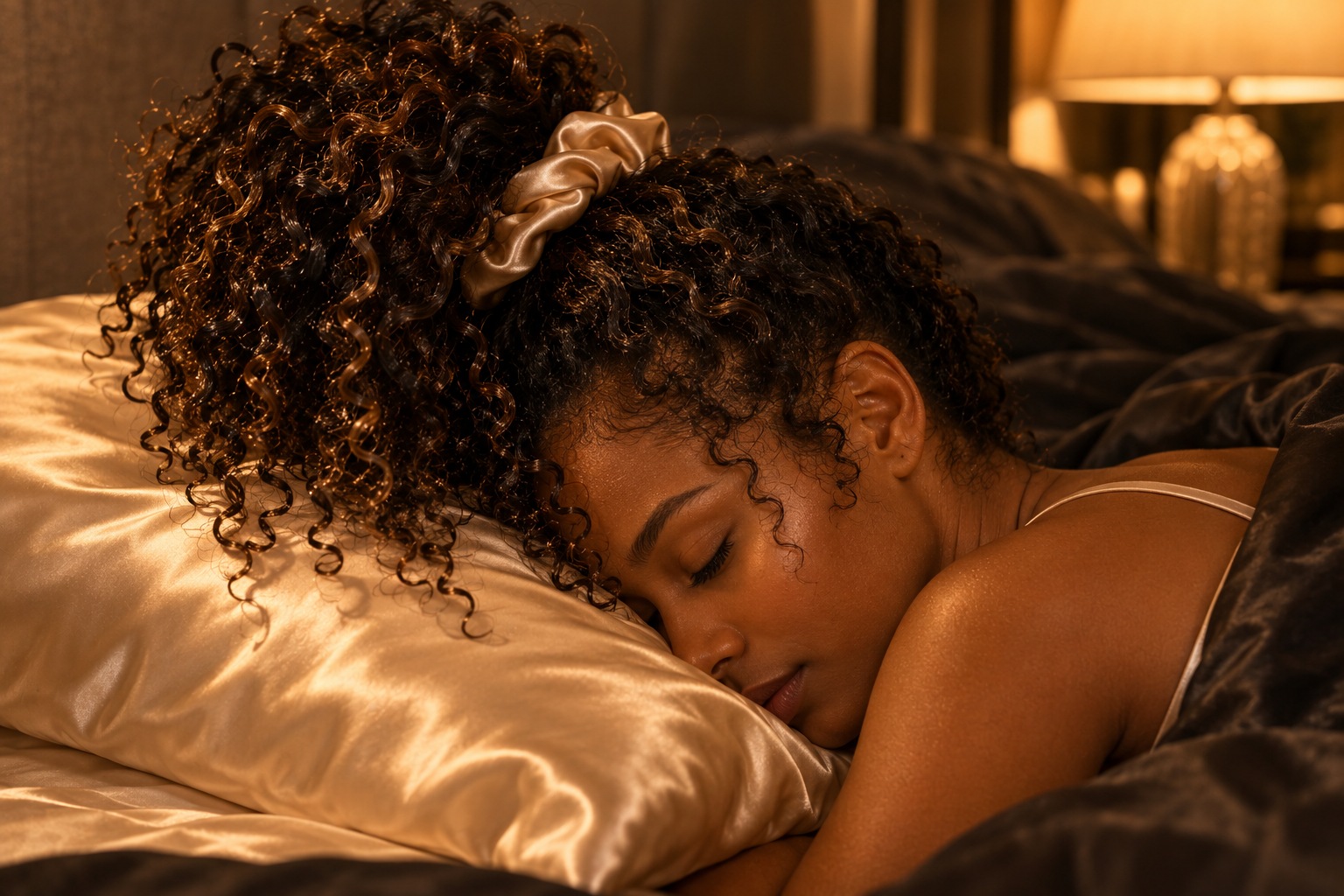
You spend a third of your life with your head on a pillow. For straight hair, that changes little. For a curl, it is eight hours of friction, absorption and crushing — enough to undo, every night, what a daytime routine has patiently built. Night is not a pause in the care of textured hair. It is its most decisive moment, and the cheapest one to fix.
We touched on the subject in passing in our articles on coily hair and kinky hair. It deserves an article of its own: what really happens on the pillow, the choice between cotton, satin and silk, the night styles for each texture, and the three morning gestures that bring a curl back to yesterday's shape.
What happens while you sleep
Three things combine, and none of them is visible at the time.
Friction. Over a night, the head changes position dozens of times. With each movement, the hair slides against the pillowcase. On straight hair, whose cuticle scales lie flat, that sliding is almost without consequence. On a curl, whose cuticle opens at every bend, each rub catches a scale, lifts it, and leaves the fibre a little rougher. That is the mechanical origin of morning frizz, knots at the ends, and the small broken hairs you find on the pillow.
Absorption. Cotton is a hygroscopic fibre: that is exactly why towels are made of it. A cotton pillowcase drinks, for eight hours, the water held in the fibre and the actives of the product applied in the evening. By morning the hair is drier than at bedtime, and part of the leave-in is in the pillowcase rather than on the curl.
Crushing. The weight of the head flattens the curls on the side you sleep on, and the shape of the spiral is deformed. A curl crushed overnight does not spontaneously recover: it dries in the position it was compressed into.
No daytime routine makes up for a cotton pillow. Night does not damage a curl all at once: it wears it down, a little, every evening, for years.
Cotton, satin, silk: what really matters
The solution comes down to one idea: put between the curl and the pillow a surface that slides instead of catching, and that does not absorb. Two materials meet that specification, and the confusion between them is common.
Silk is a fibre, produced by the silkworm. Satin is not a fibre but a weave — a tight construction in which the threads float long over the face side, giving that smooth, glossy surface. Satin can therefore be woven from silk, polyester or viscose. In shops, a “satin pillowcase” almost always means polyester satin.
For the curl, the result is very close in both cases: the smooth surface reduces friction, and the material holds little water. Silk breathes better, grows softer with time, and suits scalps that sweat at night particularly well; it does, however, require gentle washing and costs considerably more. Polyester satin goes in the machine, withstands anything, and does most of the job for a fraction of the price. The choice is a matter of budget and comfort, not of effectiveness.
Three forms exist, and they are not mutually exclusive.
- The pillowcase is the simplest solution: it asks nothing of you, does not move, and protects the skin of the face as well. It covers short and mid-length hair well. On long hair, part of the lengths always ends up on the sheet or mattress, in cotton: that is its limit.
- The bonnet wraps the whole head of hair and keeps it in place; it is the most effective on long, thick or kinky hair. Choose it roomy, with a soft elastic band that does not mark the forehead, lined with satin on the inside. Models that are too tight slip off in the middle of the night or leave a line on the roots.
- The scarf, tied turban-style, suits short hair and protective styles, and anyone who dislikes bonnets. It holds better when tied over a base, such as a loose pineapple.
Pillowcase and bonnet together is the safest combination: if the bonnet slips during the night, the pillowcase takes over.
Night styles, by texture
Protecting the surface is not enough: crushing has to be avoided too. That is the role of night styles, which lift the mass of hair out of the pressure zone. Each texture has its own.
The pineapple, for wavy and curly hair (2A to 3B). The name comes from the silhouette: hair gathered very high on the crown falls back like the leaves of a pineapple. Tip your head forward, gather the lengths at the top without pulling, and hold them with a satin scrunchie wrapped once only, very loosely. The curls hang forward and to the sides, away from the pillow, and the shape of the spiral is preserved. If the scrunchie leaves a mark in the morning, it was too tight.
The multi-pineapple, for mid-length or very voluminous hair. When a single pineapple pulls at the nape or will not hold, divide the hair into two or three sections and make a loose pineapple on each. Same principle, minus the tension.
Loose twists and braids, for coily and kinky hair (3C to 4C). On these textures the pineapple compresses the curl instead of freeing it, and the hair tangles on itself. Four to eight large twists, turned without tension on slightly damp hair sealed with Condi Curl, keep the lengths stretched, prevent overnight shrinkage, and give elongated, defined curls in the morning. Undo them with fingers coated in a small amount of leave-in, no comb.
Nothing at all, for short hair. Below chin length, a pillowcase or a bonnet is enough. Night styles only make sense once the lengths can be lifted.
Before bed: what to apply, and what to avoid
The first rule is not to sleep on wet hair. Saturated with water, the fibre swells, its scales open, and it becomes far more fragile to friction: one night on soaking hair does more damage than a week of nights on dry hair. If you wash in the evening, let the hair air-dry until it is at least nearly dry, or finish with a diffuser on warm air.
On dry or barely damp hair, the evening treatment is light: a small amount of Condi Curl, emulsified between the palms, run over the lengths and ends only, where the fibre has lost most during the day. Shea Butter seals the water still present, and the plant-derived guar lays down the light film that limits friction. That is all. The aim is not to nourish overnight — that is the role of Nutri Curl, which is rinsed out — but to protect.
Why a leave-in, not a mask
The idea of “leaving a rich mask on overnight” is tempting, and it is a common mistake. A mask is formulated to be rinsed out: its butters and conditioning agents, left for eight hours without rinsing, saturate the fibre, weigh the curl down and end up in the pillowcase. A leave-in is dosed to stay: it is the only product that belongs on the pillow.
The morning in three gestures
A well-protected curl does not need to be rewashed or fully rewetted every morning: that is precisely the point of the night. It needs to be refreshed, and three gestures are enough.
- Release without pulling. Remove the scrunchie or undo the twists, tip your head forward, and shake gently at the roots with your fingers. No comb, no brush on dry hair: that is the surest way to break up the curl and create volume where you do not want it.
- Dampen, do not soak. A mist of water over the lengths, from about twenty centimetres, until the hair feels slightly damp to the touch. Water reactivates the film of product laid down the night before and gives the curl back its ability to re-form.
- Redefine. A very small amount of Condi Curl emulsified in the palms, and the scrunch: lengths pushed up towards the scalp, pressed in the hand, released. Crushed strands curl back up, frizz smooths out. Let it air-dry.
If the morning asks for more than that — a full rewet, detangling, restyling — the night has not done its job: a bonnet that slipped, a cotton pillowcase, hair that went to bed too wet. Fix the night before fixing the morning.
What you notice within two weeks
Switching to satin is one of the few routine changes whose effect shows quickly. From the first mornings, detangling takes less effort and the pillowcase no longer collects broken hairs. Within two weeks, morning frizz drops noticeably, a wash-and-go holds for two or three days instead of one, and washes can be spaced further apart — which, for a fibre that loses water at every shampoo, is the most valuable gain of all.
One last piece of advice, for travelling: a satin pillowcase fits in any suitcase, and hotel pillows are cotton.
Discover Condi Curl, our leave-in for the evening and the morning refresh.
View the product