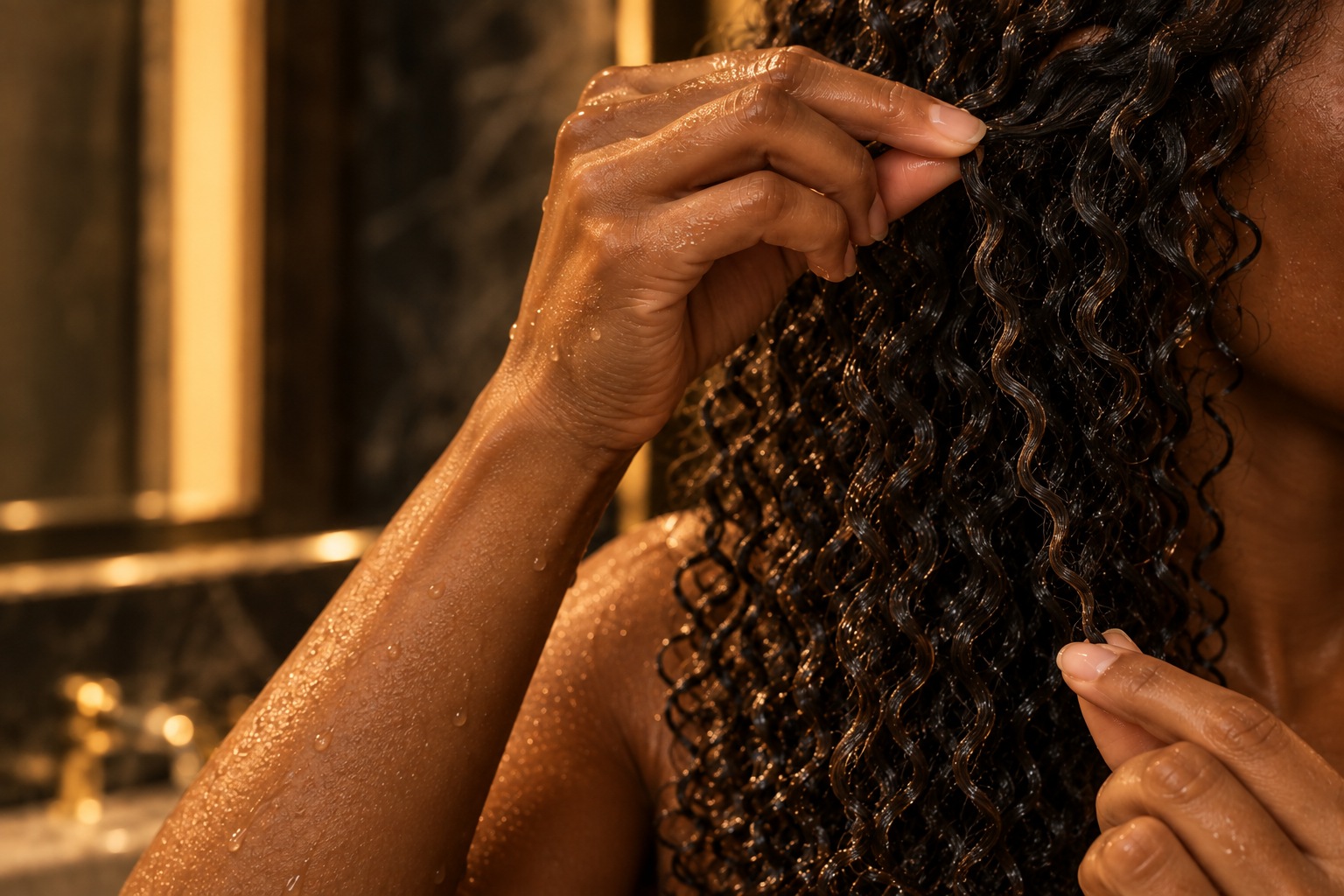
“I moisturise and moisturise, and my hair stays limp.” “I did a protein treatment and it turned as rough as straw.” Those two sentences describe the same phenomenon, seen from opposite sides. Textured hair needs water and protein — and it is the balance between the two, more than the quantity of either, that decides how supple a curl will be.
This article explains what those two needs are, how to tell in thirty seconds which one is missing, and why we chose to place hydrolysed Rice Protein and Panthenol in all three of our products at deliberately modest doses, rather than turning them into a shock treatment.
What a hair is made of
The hair fibre consists essentially of keratin, a fibrous protein coiled on itself like the strands of a rope. Keratin gives hair its strength and structure. Between those strands circulates a small amount of water, which makes the fibre supple, stretchable, able to bend without breaking. Remove the water and the rope goes stiff. Damage the keratin and the rope loses its strands and unravels.
On straight hair, both components are naturally protected by the cuticle, the layer of scales wrapped around the fibre, and by the sebum that lubricates it. On curly, coily or kinky hair, the cuticle opens at every turn of the spiral and sebum never reaches the ends — we described this in our article on porosity. Water escapes faster and keratin is more exposed. That is why the question of balance is so much sharper on a textured fibre.
The elasticity test, in thirty seconds
You do not need a laboratory to know what your hair needs. One gesture is enough, on wet hair, after shampooing and before any treatment.
Take a single strand between the thumb and index finger of each hand, and stretch it gently.
- It lengthens a little, then springs back into shape. The balance is right. The fibre holds enough water to stretch and enough protein to return to its place. Your routine is working; change nothing.
- It stretches a lot, turns soft and gummy, and does not spring back. The hair is saturated with water and lacks structure. This is the “too much moisture, not enough protein” profile. Curls feel heavy, droop, lack bounce, and the fibre breaks by stretching rather than by stiffening.
- It barely stretches and snaps cleanly, with a small click. The hair is rigid. Two possible causes, which feel alike to the touch: a lack of water, or an excess of protein that has stiffened the fibre. In both cases, moisture is the priority.
Repeat this test at each change of season, or after anything that has put the fibre under strain — a summer of sun and sea, a colour, a relaxer. The answer is not permanent: it describes the state of your hair today.
Healthy hair is neither the most moisturised nor the richest in protein. It is the hair that stretches and springs back.
What a hydrolysed protein really does
A whole protein is a molecule far too large to interact with a hair fibre: it slides over it and rinses away. For it to be of any use it must be hydrolysed — cut, by water and enzymes, into much shorter fragments called peptides. That is the meaning of the word Hydrolyzed that precedes the name of a protein on a label: Hydrolyzed Wheat Protein, Hydrolyzed Keratin, Hydrolyzed Rice Protein.
These fragments act in two ways. The smallest lodge in the breaches of the cuticle, where scales are missing or lifted, and temporarily fill the fibre from within. The larger ones form a thin film on the surface that reinforces the shaft, smooths the scales and keeps water inside. In both cases the effect is mechanical and reversible: a hydrolysed protein does not “repair” hair in any medical sense. It consolidates it, wash after wash, for as long as it is supplied.
We chose Rice Protein. It is plant-based, gluten-free and, above all, light: its peptides are small, which makes it suited to fine fibres and to curls that weigh down easily. It adds body and hold without the stiffness that some curls dislike in wheat protein or keratin. You will find it in all three ETHNEIA products — Hydra Curl, Nutri Curl and Condi Curl — at a concentration below 1 %. That figure is not timidity: it is the heart of our method, and we return to it below.
Panthenol, the other side
If protein looks after structure, Panthenol looks after water. It is provitamin B5, a small molecule with the particularity of being both a humectant — it attracts water and holds on to it — and fine enough to slip into the fibre rather than sit on its surface. Hair that receives it gains suppleness and elasticity; it stretches better, detangles better, and breaks less when styled.
That is exactly the complement a protein needs. One consolidates, the other softens; one keeps water in because it has sealed the cuticle, the other because it has drawn water inside. So we paired them in the two products that stay longest in contact with the fibre: Nutri Curl, the mask you leave on, and Condi Curl, the leave-in. Panthenol appears there just after the butters and oils, and just before Rice Protein.
In Hydra Curl, that humectant role is played by vegetable Glycerin and Erythritol, placed among the first five ingredients, and by Aloe Vera juice. A shampoo is not a treatment: it stays on the fibre only briefly. But it must not leave with the water the fibre contained.
Protein overload: what it is and where it comes from
In recent years the textured-hair community has discovered protein — and, with it, a new problem. Hair that receives too much protein, too often, ends up stiffening. The film builds up layer on layer, the fibre loses its ability to stretch, and you get the opposite of what you were after: rough, dull hair that tangles and breaks when styled. This is protein overload, which the elasticity test describes as “the strand that will not stretch”.
It almost never comes from a single product. It comes from stacking: a “strengthening” shampoo, a “reconstructing” mask, a “keratin” leave-in, an “anti-breakage” spray — each dosed to work alone, all applied in the same week. Low-porosity hair, with its tightly closed cuticle, is the most sensitive: the protein does not get in, it piles up on top.
Why we dose sparingly
We took the opposite path to the shock treatment. Rice Protein is present in each of our three products, but always below 1 %, and always accompanied by humectants and lipids that act as a counterweight. Used together, every week, they give the fibre a constant, moderate supply — the amount it uses up between two washes, never the amount that builds up. That is what allows Condi Curl to be applied every day without stiffening curls, and Nutri Curl to be used at every wash without ever weighing them down.
Adjusting the balance to porosity and season
The balance is not the same for every curl, nor all year round. Two markers are enough to adjust it.
Porosity. High-porosity hair — open cuticle, often after colouring or a summer in the sun — loses water very quickly and lacks structure. It benefits from protein, and Nutri Curl comes into its own there, at every wash, left on for fifteen minutes under a warm towel. Low-porosity hair, whose cuticle stays closed, holds what it has but lets little in: it prefers the light hydration of Condi Curl and a more spaced-out mask, every two weeks. Our article on porosity explains the test that tells you where you stand.
Season. Coming out of summer, the fibre has taken salt, chlorine and UV: the cuticle is open, the keratin weakened. This is the time of year when protein is most useful, and we devoted a four-week protocol to that rebuilding. Conversely, dry winter air and heating draw water out of the fibre without damaging its structure: the emphasis shifts to moisture, and Condi Curl takes over day to day.
Reading a label: spotting proteins and humectants
A few words are enough to tell, in the shop, which family a product belongs to.
- Proteins carry the prefix Hydrolyzed: Hydrolyzed Rice Protein, Hydrolyzed Wheat Protein, Hydrolyzed Keratin, Hydrolyzed Silk, Hydrolyzed Soy Protein. Amino Acids (Arginine, Wheat Amino Acids) are their shortest form. Placed among the first five ingredients, they signal a full protein treatment, not to be combined with another.
- Humectants are called Glycerin, Panthenol, Erythritol, Aloe Barbadensis Leaf Juice, Sodium PCA, Betaine, Hyaluronic Acid. They attract water. High on the list, they make a product a moisturising treatment.
- Emollients are the butters, oils and fatty alcohols — Butyrospermum Parkii Butter, Persea Gratissima Oil, Cetyl Alcohol. They hold in the water the humectants have brought. A moisturiser without emollient evaporates; an emollient without humectant seals an empty fibre.
On our three labels, the reading is simple: humectants at the top (Erythritol, Glycerin, Aloe), emollients next (Avocado, Kokum, Baobab, Shea), Panthenol and Rice Protein in support, below the 1 % line. You will find them reproduced in full in our article on sulfate-free, silicone-free formulas.
In practice: rebalancing in three weeks
If the elasticity test gave you a soft strand that does not spring back, the fibre lacks structure. Use Nutri Curl at every wash for three weeks, fifteen minutes under a warm towel, and cut back on rich styling oils and creams that weigh the curl down further. Repeat the test: the strand should now spring back.
If the strand snapped cleanly, rigid, start by removing from your bathroom everything that stacks protein — strengthening sprays, reconstructing masks from other brands, keratin treatments. Keep the three ETHNEIA products, whose doses are designed to coexist. Apply Condi Curl every day on damp hair, and make Nutri Curl a fortnightly appointment while the fibre recovers its water. Three weeks are usually enough for the strand to stretch again.
In either case, do not chase the opposite excess. The goal is not the most moisturised hair, nor the strongest. It is the hair that stretches, and springs back.
Discover Nutri Curl, our mask with Panthenol and Rice Protein.
View the product