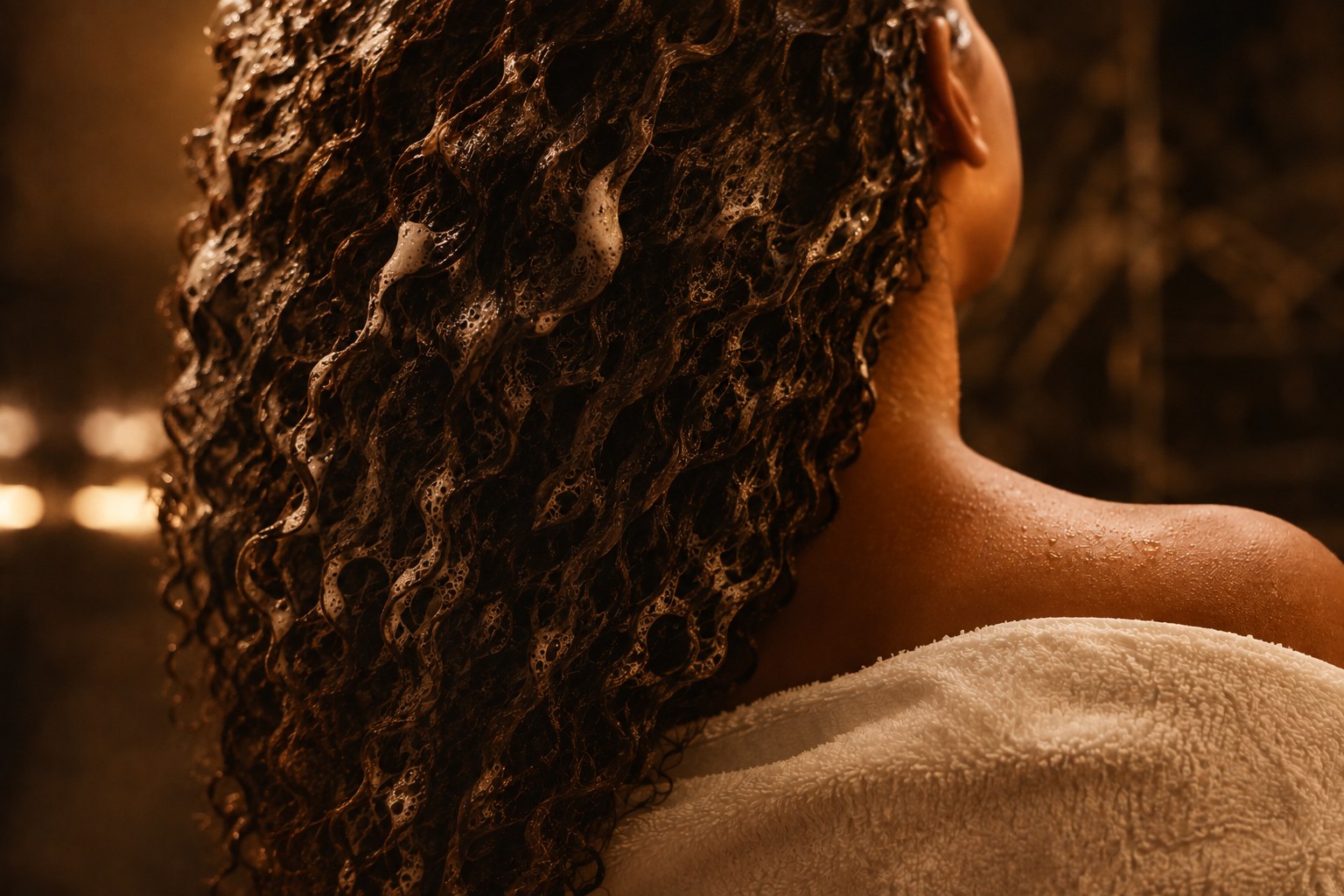
"Sulfate-free, silicone-free" has become a packaging formula. You read it everywhere; it is almost never explained. Yet behind those two words lies the most concrete reason a curl turns dry, dull or brittle — and the reason our shampoo lathers less than the one you were used to.
This dossier is not out to demonise a family of ingredients. Sulfates and silicones are effective, inexpensive, perfectly legal molecules, present in the majority of hair products on the market. The question is not whether they are "good" or "bad". The question is what they do, precisely, to a textured fibre — and why a house devoted exclusively to that fibre chose to do without them.
A sulfate — what is it, exactly?
A shampoo cleans thanks to surfactants: molecules with one end that loves water and another that loves oil. They latch onto sebum, dust and styling-product residue, and carry them away at the rinse. Without a surfactant, there is no washing. "Sulfate-free" therefore does not mean "surfactant-free": it means the main surfactant does not belong to the sulfate family.
The most common sulfates are called Sodium Lauryl Sulfate (SLS), Sodium Laureth Sulfate (SLES) and Ammonium Lauryl Sulfate (ALS). They are so-called anionic surfactants, and particularly powerful ones: they dissolve oil with remarkable efficiency and produce an abundant, dense, instant lather. That is why they are also found in washing-up liquids and shower gels.
The problem is not their efficiency. It is their lack of discernment. A sulfate makes no distinction between the excess sebum that should go and the hydrolipidic film that should stay. It takes everything.
Why a curl tolerates it less than straight hair
On straight hair, the sebum produced by the scalp slides down the shaft within hours and lubricates the whole length. An energetic wash removes the excess; it is replenished by the next day. The cycle is short, and the sulfate fits into it.
On wavy, curly, coily or kinky hair, sebum does not travel. Every curve, every angle of the fibre is an obstacle. Roots can get oily again while the ends have been dry for weeks — we described this in detail in our dossiers on coily hair and kinky hair. The little oil that does reach the lengths is precious. It is what keeps the cuticle scales lying flat, what holds water inside the fibre, what gives the curl its suppleness.
A sulfate strips that film away in a single application. The cuticle lifts, water escapes, the fibre swells and then contracts as it dries. The immediate result: hair that "squeaks" under the fingers, a curl that frizzes, detangling that pulls. The medium-term result: rising porosity, and ends that break.
A sulfate does not dry out textured hair because it is aggressive. It dries it out because it is efficient — on a fibre that has no reserves.
Lather, the false witness
It is the question we are asked most often, and it deserves a straight answer: yes, Hydra Curl lathers less than a conventional shampoo. And it is meant to.
Lather plays no role in cleansing. It is a side effect of sulfated surfactants, which the industry ended up holding up as proof of efficacy because we have been conditioned to it since childhood: lots of foam, so it must be working. Yet it is precisely the molecules that foam the most that strip the most.
The gentle surfactants used in sulfate-free formulas — derived from sugar, coconut or amino acids — cleanse while respecting the hydrolipidic film. Their lather is finer, creamier, slower to build. It calls for a different gesture: a sulfate-free shampoo is applied to very wet hair and worked with the fingertips over the scalp, not by rubbing the lengths. On hair loaded with gel, wax or styling oil, a quick second wash is enough — the first application emulsified the residue, the second carries it away.
Silicones: instant shine, and the debt
If sulfates are the strippers, silicones are the make-up artists. They are synthetic polymers, born of silicon chemistry, that settle on the fibre as a smooth, waterproof, extremely glossy film. In the shower, the effect is spectacular: the comb glides, the curl looks defined, the hair shines as it dries.
But that film nourishes nothing. It covers. It keeps water from getting out — that is its merit — and it keeps everything else from getting in: the water of the next rinse, the oils of a mask, the actives of a leave-in. Hair coated in silicone is hair that looks hydrated and no longer is. Week after week, the fibre dries out beneath its varnish, and the day the film cracks, breakage appears all at once, without warning.
Most classic silicones — Dimethicone, Cyclopentasiloxane, Amodimethicone — are not water-soluble. They build up from one wash to the next. And to remove them, only one thing really works: a powerful surfactant. A sulfate.
The sulfate–silicone circle
The sulfate strips the fibre. To mask the dryness, you apply a silicone-laden conditioner. The silicone builds up and smothers the fibre. To remove the silicone, you need a sulfate. Each step justifies the next — and the hair never receives what it actually needs. Leaving the circle takes only one decision: stopping both at the same time.
Reading an INCI list in thirty seconds
Every cosmetic composition sold in Europe is displayed in a precise order: ingredients are ranked by decreasing concentration down to the 1 % threshold, then in any order below it. The first five names generally account for more than 80 % of the formula. The rest is detail.
You do not need to know chemistry to spot what matters. A few reflexes are enough:
- The word "Sulfate" in a shampoo's first three ingredients signals a stripping wash. Sodium Lauryl Sulfate, Sodium Laureth Sulfate, Ammonium Laureth Sulfate: same family.
- Endings in "-cone", "-conol" and "-siloxane" are silicones. Dimethicone, Amodimethicone, Cyclomethicone, Phenyl Trimethicone. Placed high on the list of a mask or leave-in, they are its main active — not the oils named on the label.
- So-called "water-soluble" silicones often carry the prefix PEG- or PPG- (PEG-12 Dimethicone). They rinse out more easily, but remain inert films that nourish nothing.
- Where the noble ingredients sit. A butter or plant oil listed after the fragrance (Parfum or Fragrance) is present below 1 %: it is there for the label, not for the hair. We covered this in our dossier on the botanical treasures of Nutri Curl.
- The percentage of natural origin is a useful indication, provided it is precise. A "98 %" says something. A "natural" without a number says nothing.
- A false friend: "Methosulfate". Behentrimonium Methosulfate contains the word, but does not belong to the family. It is not a cleansing agent: it is a conditioner derived from rapeseed oil, one of the gentlest there is, accepted by natural-cosmetics standards. You find it in masks and leave-ins, never as a stripper. We use it, and we stand by it.
What we put in, and what we leave out
The three ETHNEIA products are formulated without sulfates, without silicones, without parabens, and are 100 % vegan. Their natural-origin content runs from 96.5 % for Condi Curl to 98 % for Hydra Curl. The remainder — a few percent — covers the preservation and stabilising agents without which a water-based product would not keep for twelve months in a bathroom.
In place of sulfates, Hydra Curl washes with three gentle surfactants: Sodium Cocoyl Glutamate, derived from an amino acid and coconut oil; Decyl Glucoside, obtained from sugar and coconut; and a touch of Cocamidopropyl Betaine, which softens the lather further. They are backed by Aloe Vera, Jojoba Oil, Olive Oil and vegetable Glycerin: the wash removes what it should and leaves the hydrolipidic film in place. In place of silicones, Nutri Curl and Condi Curl rely on butters and oils that penetrate the fibre — Kokum, Baobab, Castor and Avocado for the mask, Shea for the leave-in — and on Rice Protein, which fills the breaches in the cuticle instead of covering them.
The shine obtained this way is less immediate than a silicone's. It is also the only shine that comes from inside the fibre, and the only one still there after the next rinse.
Our three labels, read closely
Since we invite you to read INCI lists, let us begin with our own. Here they are as they appear in our regulatory files, in decreasing order of concentration.
Hydra Curl — Cleansing shampoo
Aqua, Erythritol, Sodium Cocoyl Glutamate, Glycerin, Decyl Glucoside, Olea Europaea Fruit Oil, Aloe Barbadensis Leaf Juice, Parfum, Simmondsia Chinensis Seed Oil, Xanthan Gum, Cocamidopropyl Betaine, Propylene Glycol, Benzyl Alcohol, Hydrolyzed Rice Protein, Sodium Chloride, Lactic Acid, Benzoic Acid, Sorbic Acid, Decyl Alcohol, Glucose, Sodium Benzoate, Citric Acid, Potassium Sorbate, Hexamethylindanopyran, Hexyl Cinnamal.
What to see in it: two gentle surfactants in third and fifth position, where a conventional shampoo would show a Sodium Laureth Sulfate. Erythritol and Glycerin, two humectants, come before the cleansing agents themselves. No silicone, no paraben: preservation rests on benzyl alcohol and food-grade acids (benzoic, sorbic).
Nutri Curl — Hair mask
Aqua, Persea Gratissima Oil, Cetyl Alcohol, Garcinia Indica Seed Butter, Adansonia Digitata Seed Oil, Erythritol, Ricinus Communis Seed Oil, Behentrimonium Methosulfate, Panthenol, Parfum, Hydrolyzed Rice Protein, Benzyl Alcohol, Butylene Glycol, Tocopherol, Benzoic Acid, Helianthus Annuus Seed Oil, Sorbic Acid, Sodium Benzoate, Citric Acid, Hexamethylindanopyran, Juniperus Virginiana Oil, Hexyl Cinnamal.
What to see in it: Avocado Oil in second position, Kokum Butter in fourth, Baobab and Castor right behind — the actives we name are the ones we dose. Cetyl Alcohol is not a drying alcohol: it is a fatty alcohol, obtained from plant oil, which gives the mask its creamy texture and its slip. And Behentrimonium Methosulfate is the false friend described above: it is what detangles, in place of a silicone.
Condi Curl — Leave-in conditioner
Aqua, Butyrospermum Parkii Butter, Caprylic/Capric Triglyceride, Erythritol, Glycerin, Aloe Barbadensis Leaf Juice, Behentrimonium Methosulfate, Cetyl Alcohol, Stearic Acid, Palmitic Acid, Parfum, Panthenol, Benzyl Alcohol, Butylene Glycol, Hydrolyzed Rice Protein, Guar Hydroxypropyltrimonium Chloride, Benzoic Acid, Sorbic Acid, Sodium Benzoate, Citric Acid, Potassium Sorbate, Hexamethylindanopyran, Hexyl Cinnamal, Limonene.
What to see in it: Shea Butter in second position, followed by a coconut-derived triglyceride, then two humectants and Aloe. Guar Hydroxypropyltrimonium Chloride, derived from guar gum, forms on the fibre the light film that defines the curl and tames frizz — it is, in a word, what we use where others put a silicone. Panthenol (provitamin B5) and Rice Protein complete the care. Here again: no silicone, no paraben.
The only reproach one could make of these lists is their length towards the end: preservatives, pH regulators, declared fragrance allergens. That is the price of a water-based product that stays stable for twelve months, and of a European regulation that requires everything to be named — including what is present below 0.1 %.
The first weeks: the transition
Moving from a conventional routine to one without sulfates or silicones often brings early disappointment — and it is better to know beforehand. For two to four weeks, hair can feel rougher, look less shiny, resist detangling. It is not the new product failing. It is the old silicone film leaving in layers, revealing the true state of the fibre underneath.
Three gestures shorten the transition:
- One last clarifying wash with your old sulfated shampoo, to remove as much residue as possible in one go — then retire it.
- Nutri Curl at every wash during the first month, with a fifteen-minute pause under a warm towel: the moment when the fibre, at last accessible, truly feeds.
- Condi Curl every day, on damp or dry hair, to maintain hydration between washes while the cuticle closes again.
Past that point, the difference is no longer a matter of shine in the shower. It shows in detangling that no longer pulls, in a curl that bounces instead of collapsing, and in ends that hold from one haircut to the next.
Neither dogma nor marketing
We do not claim that a sulfate is poison, or a silicone a scandal. On straight, oily hair washed daily, a sulfated shampoo does its job honestly. On textured hair, the cost-benefit ratio flips: what it removes is worth more than what it cleans.
It is for that fibre, and that fibre alone, that ETHNEIA was conceived. "Sulfate-free, silicone-free" is not a marketing promise added to the label after the fact. It is where the formula begins.
Discover Hydra Curl, our sulfate-free cleansing shampoo.
View the product